Ratio Simplifier
Use this free Ratio Simplifier to quickly reduce any ratio to its lowest terms with a step-by-step explanation. Our Calculator works with integers, decimals, and multi-part ratios in seconds.
What Is a Ratio Simplifier?
A ratio simplifier is a mathematical tool that reduces a ratio to its smallest possible equivalent form without changing the relationship between the numbers. When two or more numbers are written as a ratio, such as 12:18, they can often be reduced by dividing each part by their greatest common divisor.
For example, 12:18 simplifies to 2:3 because both numbers share a common factor of 6. Dividing both values by 6 keeps the proportion exactly the same but expresses it in a cleaner, easier-to-read format.
Simplifying ratios is important in many real-world situations. It helps make comparisons clearer, improves readability in math problems, and ensures accurate proportions in recipes, scaling measurements, finance, construction, design, and statistics.
This online tool automatically performs that calculation for you, ensuring accuracy and speed without manual effort.
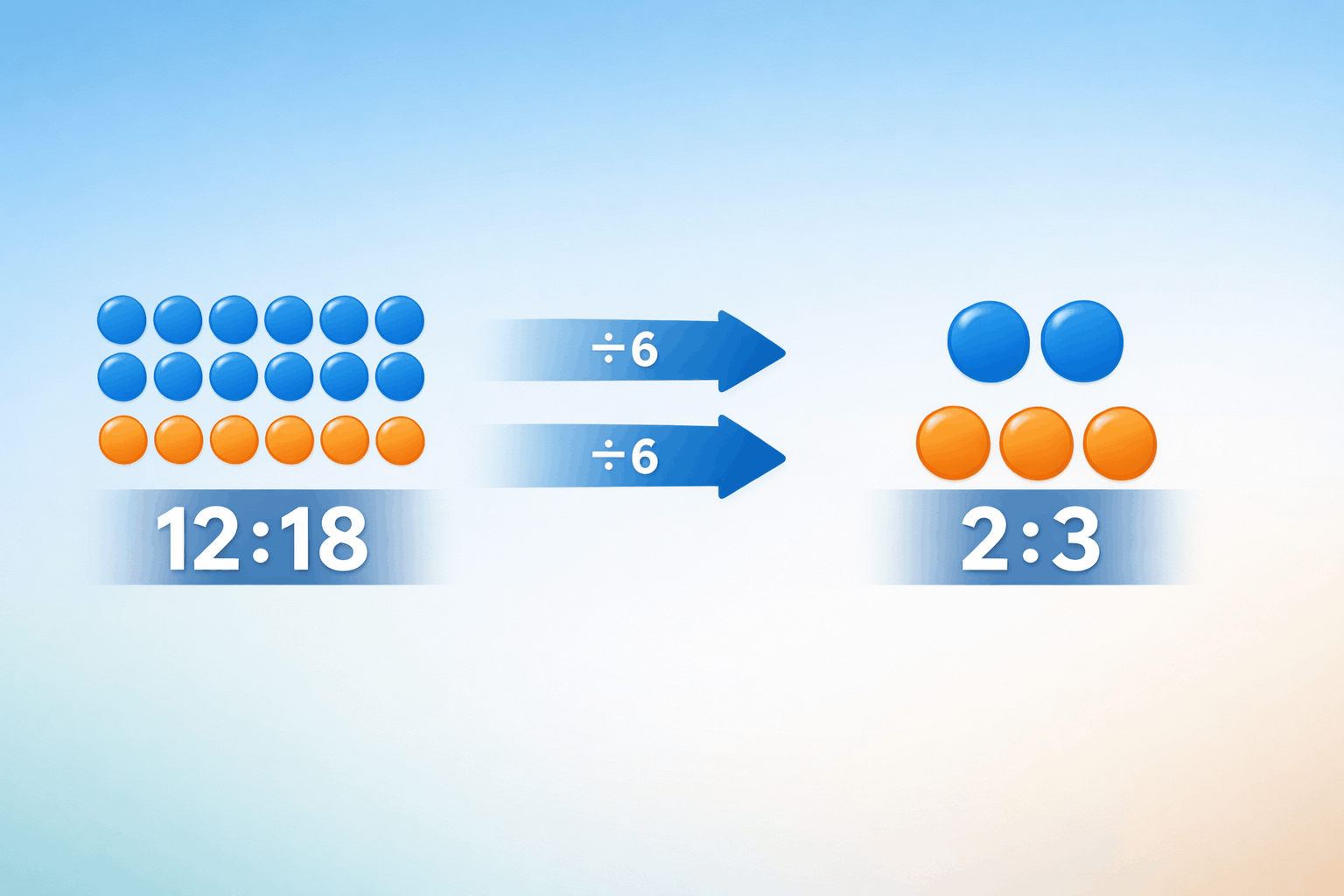
Table of Contents
How This Ratio Simplifier Works
This Ratio Simplifier follows a clear three-step mathematical process to reduce any ratio accurately while preserving the original proportional relationship.
The entire process is designed to be accurate, fast, and beginner-friendly, making this Ratio Simplifier useful for students, professionals, and anyone who needs reliable ratio reduction without complicated calculations.
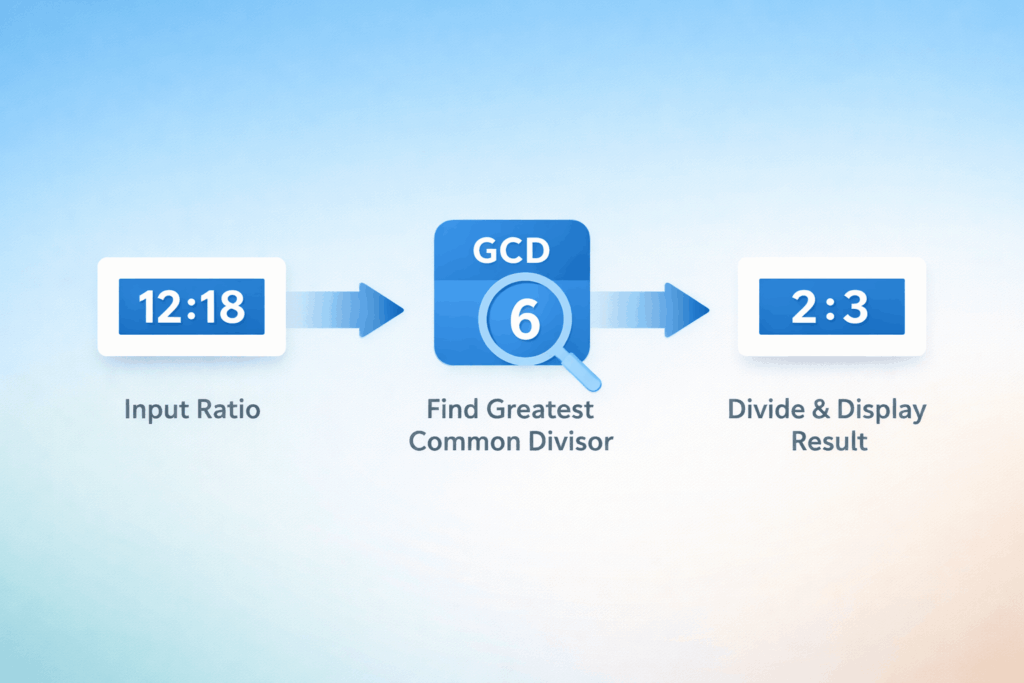
Enter and Identify the Ratio
When you enter a ratio into the calculator, the system first reads and validates the input. It accepts colon-separated ratios like 8:12, slash formats such as 8/12, and multi-part ratios like 4:6:8.
The tool extracts each numeric value and checks for valid formatting. If decimals are included, they are processed carefully to avoid rounding issues. This ensures the calculation starts with clean, accurate data.
Calculate the Greatest Common Divisor
After identifying all parts of the ratio, the calculator finds the greatest common divisor across the numbers. The greatest common divisor is the largest number that divides evenly into all parts of the ratio.
For example, in 12:18, the greatest common divisor is 6.
In 12:18656, the greatest common divisor is 4.
If decimals are entered, the tool first converts them into proportional whole numbers before calculating the divisor. This prevents precision errors and guarantees mathematical correctness.
Divide and Display the Simplified Ratio
Once the divisor is found, each part of the ratio is divided by that value. This produces the smallest possible whole-number ratio that maintains the same proportional relationship.
The final output clearly displays:
• The original ratio
• The simplified ratio
• The scaled ratio (if a multiplier is applied)
• A step-by-step explanation (optional toggle)
This three-step process ensures that the simplified ratio remains mathematically accurate while being easier to understand and use in real-world applications.
Why Simplifying Ratios Matters
Simplified ratios make comparisons easier to understand. In mathematics, reduced ratios are easier to interpret and calculate with. In cooking, reducing ingredient proportions prevents confusion. In engineering or architecture, simplified proportions ensure accurate scaling.
For example, if a blueprint shows a ratio of 50:75, simplifying it to 2:3 makes the relationship clearer and easier to apply. The numbers are smaller but represent the same proportional balance.
In statistics and data analysis, simplified ratios help communicate results more effectively. Large numbers can obscure the actual relationship between quantities, while reduced ratios clarify it instantly.
This is why professionals and students alike rely on accurate simplification tools.

Features
• Two-part and multi-part ratios
• Whole numbers and decimals
• Large numeric values
• Instant simplification
• Scaling after simplification
• Swap functionality for two-part ratios
• Step-by-step explanation display
• One-click copy of simplified result
• Clear error validation for invalid inputs
If a ratio is already in simplest form, the calculator confirms it instead of altering the result unnecessarily. It also handles edge cases like negative values consistently and avoids floating-point rounding issues.
The goal is accuracy, clarity, and reliability.
Understanding the Math Behind Ratio Simplification
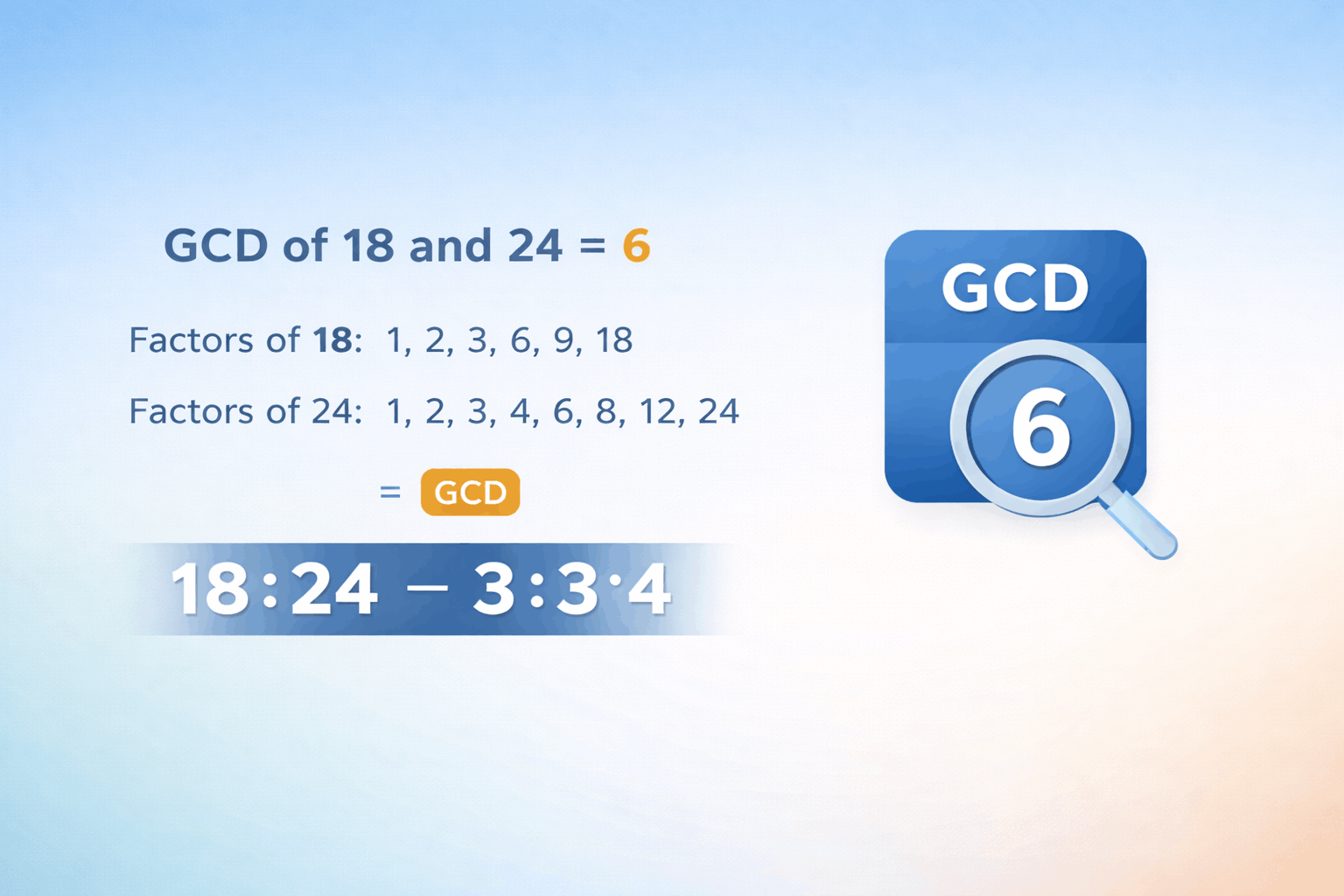
At the core of every simplified ratio is the greatest common divisor. The greatest common divisor, often abbreviated as GCD, is the largest number that divides evenly into all parts of a ratio.
For example: 18:24
The GCD of 18 and 24 is 6.
Dividing both numbers by 6 results in 3:4.
This works because division by a common factor preserves proportional relationships. The numbers become smaller, but the comparison remains identical.
For multi-part ratios like 6:9:15, the calculator finds the GCD across all values before dividing each one. This ensures consistency and correctness across complex inputs.
When decimals are involved, the system first converts them into proportional whole numbers before simplifying.
This mathematical foundation guarantees precise results.
Common Real-World Uses for Ratio Simplification

Simplifying ratios appears in many areas of daily life:
• Cooking and baking recipes
• Financial comparisons and budgeting
• Scale drawings and blueprints
• Sports statistics
• Chemical mixtures
• Academic math problems
• Business performance analysis
• Graphic design proportions
For example, if a recipe calls for 200 ml of milk and 300 ml of water, the simplified ratio is 2:3. This makes scaling up or down much easier.
Students use ratio reduction in algebra and geometry, while professionals use it in engineering and data analysis.
A reliable tool saves time and eliminates calculation mistakes.
How to Use This Ratio Simplifier
Using the calculator is straightforward.
1. Enter your ratio using a colon, slash, or multiple values separated by colons.
2. Click the simplify button.
3. View the simplified result instantly.
4. If needed, apply a scale multiplier to expand the ratio proportionally.
5. You can also swap the sides of a two-part ratio to reverse the comparison.
The calculator automatically validates your input and explains the steps taken. This makes it helpful not only for quick calculations but also for learning.
If you would like a deeper explanation of how ratio simplification works step by step, you can watch this detailed video tutorial on YouTube for a visual walkthrough and additional examples.
Ratio Simplifier vs Ratio Calculator: What Is the Difference?
Ratio Simplifier
A ratio simplifier focuses specifically on reducing ratios to their lowest equivalent terms.
Ratio Calculator
While a general ratio calculator may perform additional operations such as comparing ratios, converting to fractions, or solving proportions.
Our Calculator specializes in accurate reduction while also allowing scaling and swapping, giving you precision without unnecessary complexity.
Frequently Asked Questions
Find clear answers to common questions about ratio simplification, proportional relationships, and how to reduce ratios accurately, all explained in a simple and easy-to-understand way.
What does a ratio simplifier do?
It reduces a ratio to its smallest equivalent form while preserving the same proportional relationship.
How is a ratio simplified?
By dividing all parts of the ratio by their greatest common divisor.
Can this tool simplify decimal ratios?
Yes, decimal inputs are converted into proportional whole numbers before simplification.
Does simplifying change the meaning of a ratio?
No, it keeps the same proportional relationship.
Can I simplify ratios with more than two numbers?
Yes, multi-part ratios are fully supported.
What happens if the ratio is already simplified?
The tool confirms that it is already in lowest terms.
Can I scale a simplified ratio?
Yes, you can multiply it by a chosen value after simplification.
Does this calculator work with large numbers?
Yes, it handles large numeric inputs accurately.
What separators can I use?
Colon, slash, or multi-value colon-separated inputs are accepted.
Why is simplifying ratios important?
It improves clarity, accuracy, and ease of calculation.
Some of our popular calculators: